

SYDNEY 30 May 2019: Foodbank’s national milk program partners – Parmalat, Lion Dairy & Drinks, Fonterra and Saputo Dairy Australia have collectively received the 2019 Foodbank Award for their collaboration to fight hunger in Australia.

Presented at the Food & Grocery Australia conference dinner held by the Australian Food & Grocery Council (AFCG) in Sydney yesterday, Foodbank praised its dairy partners for the extraordinary collaboration with regular contributions on the production of fresh milk to help Foodbank provide relief to more than 710,000 Australians every month.

Announcing Foodbank’s highest accolade, Foodbank Australia CEO, Brianna Casey, said; “This prestigious award is presented to an AFGC member or members showing vision, innovation and leadership in partnering with Foodbank to deliver greater impact in providing food and groceries to vulnerable families across Australia.

“This year, our dairy partners receive the award for what has proven to be an extraordinary eight-year collaboration providing 1 million litres of fresh milk a year. This industry sector program is unique to Australia and sets a benchmark for foodbank/industry partnerships around the world.

“Without the support of generous partners such as these wonderful milk companies, we would simply not be able to assist the millions of Australians accessing food relief from our network of 2,600 charities around the country.

“Despite facing turbulent industry and market conditions, Parmalat, Lion Dairy & Drinks, Fonterra and Saputo Dairy Australia supply Foodbank with fresh milk in every state and territory each and every week of the year. This allows school students around the country to have milk on their cereal when they sit down at a breakfast club, it enables pensioners to add milk to their cup of tea or coffee at the drop in centre and it provides families with a staple ingredient for meals such as mac and cheese,” Casey explained.

Also on the night, the Flight Centre Foundation’s General Manager, Anita Russell, was inducted into the Foodbank Hall of Fame. Announcing the induction, Casey said: “Anita has been at the centre of the Flight Centre/Foodbank relationship since its inception seven years ago. Not only is it an incredibly valuable partnership for Foodbank but, thanks to Anita, it is the north star of corporate engagement.

“From workplace giving recruitment drives to ‘The World’s Biggest Hamper Pack’, Anita has repeatedly challenged and motivated us and her Flight Centre colleagues to do more and achieve more. No idea has ever been too big or too crazy once Anita her applied her ‘can do’ magic.

“Thanks to her passion and energy, the relationship has gone from strength to strength such that Flight Centre staff and company have funded 8.2 million serves of long life milk as well as 2.4 million serves of pasta sauce, canned fruit and rice,” Casey said.
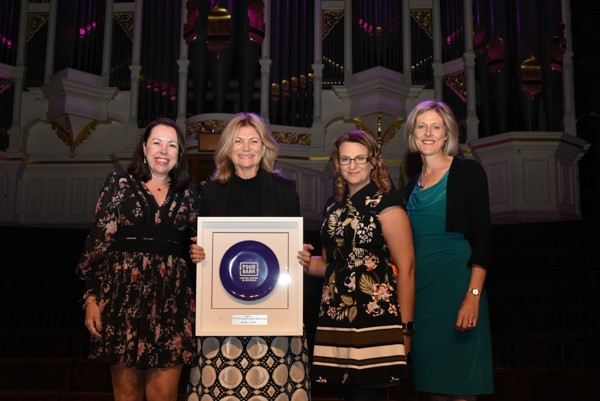
As a long-standing supporter of Foodbank, the Australian Food and Grocery Council (AFGC) provides a platform for Foodbank to present the Annual Foodbank Award at its premier, annual event, Food and Grocery Australia Dinner. Foodbank thanks the AFGC for allowing it to celebrate Foodbank hunger fighters and congratulates its award recipients.
Hunger in Australia an election priority: Foodbank


8 April 2019 –Australia’s largest food relief organisation, Foodbank, has called on all sides of politics to ensure vulnerable families – especially those struggling to put food on their tables – are not forgotten in the lead-up to the federal election and beyond.

“This election presents an opportunity for our political leaders to acknowledge that Australia has a hunger problem, and commit to a long-term plan to do something meaningful about it,” Foodbank Australia CEO, Brianna Casey said today.

Foodbank currently provides food relief to more than 710,000 Australians each month, a quarter of whom are under the age of 19. The organisation’s latest research reveals that a startling 4 million Australians experienced food insecurity last year.

“While the circumstances that led them to their situations might be markedly different, what unites food insecure Australians is an overwhelming sense of helplessness” Ms Casey said. “This election presents an opportunity for our political leaders to deliver hope to hungry Australians by uniting on an enduring policy legacy that will benefit generations to come”.

Foodbank has warned that current duelling over tax breaks could distract from the very real problem facing so many Australians right now – uncertainty over where their next meal is coming from and the stigma and shame experienced when sending their children off to school with an empty lunchbox.

“The time has come to stop the short-term, band-aid solutions to hunger in Australia and deliver the country’s first ever National Food Security Strategy,” Ms Casey said. “We want 2019 to be the year we turn a corner as a nation and deliver outcomes capable of ensuring all Australians can live with dignity and have access to sufficient, safe and nutritious food.”

“There is not an electorate in this country that is not touched by food insecurity. It affects families, students, the elderly and people with disabilities. Almost half are employed and, most heartbreaking of all, 22% are children. In fact, children are more likely to be food insecure than adults in Australia today,” she explained.

“There is currently no cohesive federal policy platform or meaningful long-term funding underpinning the goal of individual food security in Australia,” Ms Casey went on to say. “In the absence of government action, we have started the process and call on an election commitment to develop a long-term policy that will ensure zero hunger by 2030.”

Foodbank’s case for a National Food Security Strategy can be found here and its policy and funding priorities ahead of the federal election can be found here.

Foodbank also supports ACOSS and its call to raise Newstart Raise the Rate.


Global FoodBanking Network certification


Foodbank completed a week long re-certification profess with The Global FoodBanking Network (GFN) in February.

Foodbank is one of 32 GFN member countries, only 19 of which are formally certified. The thorough process included a check of brand awareness, donor stewardship, food handling, recalls, advocacy, hunger messaging and much more.

We are thrilled to report that Foodbank Australia was noted to be ‘exceeding global best practice’ in many ways and that we have retained our Global Foodbanking certification.

featured image

featured image

Foodbank hits bittersweet milestone of 600 million meals for hungry Australians

28 February 2019 – The year was 1992: Paul Keating was Australia’s Prime Minister, Boys II Men’s End of the Road was playing incessantly on the radio, summer Olympics were being celebrated in Barcelona, and Foodbank first started sourcing food for distribution to charities with one purpose – to feed hungry Australians.

Fast forward to February 2019 and Foodbank has just surpassed 600 million meals for vulnerable Australians.

To put this into context, in 1992 Foodbank provided almost 200,000 meals for the entire year. Now in 2019, Foodbank provides the same number in a single day, providing food relief to more than 710,000 people a month who are in crisis, dealing with the anguish and despair of not knowing where the next meal is coming from for themselves and their families.

Foodbank Australia CEO, Brianna Casey, today visited Parramatta Mission, one of the 2,600 charity agencies Foodbank provides relief to, helping serve lunch to just some in the local community affected by food insecurity.

“We are so fortunate to have a national network of charities like Parramatta Mission, to help us get essential food and groceries to some of the most vulnerable in our communities.

“This is a milestone we never wanted to hit. Whilst I am incredibly proud of the efforts of the entire Foodbank family, our charity network, our food and grocery donors and our partners right across the country in helping us provide the equivalent of 600 million meals, this is a bittersweet moment. It is evidence of the scale of the hunger problem we have here in Australia, and the growing need for food relief.

Foodbank works with the entire food and grocery supply chain, rescuing ‘perfectly imperfect’ fresh fruit and vegetables; sourcing – and even manufacturing – the everyday essentials every family should have available in their pantries year round; and helping fill the tummies of children who would otherwise go to school hungry.

“With 4 million Australians suffering from food poverty at some point in the last 12 months, and charities reporting increased demand for food relief across a range of demographics, something has to give. We need urgent action on what has become a systemic problem in Australia, and in the lead-up to the election, all sides of politics can expect to hear more from Foodbank on this issue.” Said Ms Casey.

Foodbank brings the heart of Christmas to the red centre

Foodbank Australia, 20 December 2018 –The burden of feeding loved ones on Christmas day will be eased for vulnerable families in Alice Springs. Foodbank, together with one of its national partners, Virgin Cargo, transported Christmas hampers from Darwin to Alice Springs to help feed the hungry through the Salvation Army Alice Springs.

Delivering these hampers was Foodbank’s inaugural Youth Ambassador, 10-year-old Alice Ramsay, who boarded a Virgin Australia flight in Sydney with her mum and travelled to Alice Springs to bring joy to those doing it tough this Christmas.

Alice has been donating food and other necessities to homeless people around Sydney since she was six years old. She has funded her food drives with stalls selling sweets and homemade lipsticks, bake sales at after school care and via her mum’s Facebook page. Passionate to help on a bigger scale, she has teamed up with Foodbank as the first Youth Ambassador for the food relief organisation and is thrilled to be heading to the red centre to do what she loves doing – feeding the hungry.

“It really makes me sad to see people without food and warm clothes. I really enjoy holding my stalls to raise money for charity, I have been raising money at my after school care the last few weeks to help pay for the hampers and I’m super excited to be in Alice Springs and helping families in the Northern Territory who need our help,” Alice said.

Foodbank Australia CEO, Brianna Casey, witnessed first-hand Alice’s determination to raise funds for people in need and was blown away by her resourcefulness in engaging her local community, particularly through after school care. She knew instantly that Alice was someone special that Foodbank would be humbled to have on board to help fight hunger.

“I don’t know many 10-year-olds who would give up playing with friends to bake and sell cakes to raise money for those in need. Not only does Alice raise money, she also researches what she needs to buy, purchases it all, with the help of Mum, and ropes in friends to help deliver what can sometimes be two trolley loads filled with bags of food and essentials for vulnerable people in our community.”

Virgin Australia has been supporting Foodbank for more than five years and jumped at the chance to actively get involved with Foodbank’s campaign to ‘Bring the heart of Australia together this Christmas’. Aimed at its corporate partners, Foodbank’s goal is to raise much needed funds to get more food to Aussies doing it tough and to highlight the social isolation many Australians experience as a result of food insecurity, especially during the festive season.

Virgin Australia Cargo General Manager, Glen Moloney, said that Virgin Australia was pleased to help Foodbank provide an important service to the heart of Australia and communities in remote areas.

“We are always looking for opportunities to give back to the community. At Virgin Australia Cargo, we understand that our services can make a big difference to remote communities who may not have access to goods and services and we are pleased to help with such worthwhile causes,” he said.

The hampers, packed by the generous team and volunteers at Foodbank in Darwin, were filled with essential food items to help vulnerable families celebrate this festive season. Foodbank in the Northern Territory works extremely hard with limited resources throughout the year. They currently provide food relief to over 10,000 people each month, but demand is significantly outstripping supply. In fact, Foodbank needs 87% more food in the NT to meet the existing demand for food relief there.

“Whilst Christmas in Australia generally involves bringing the family together to share a meal, that meal can be hard to come by for many,” Ms Casey said. “We are so pleased that Foodbank is able to add some Christmas cheer by helping to provide food relief to some of the most vulnerable in our community”.

Meal matchmaker revolutionises food relief

5 December 2018 – More meals left over at the end of the day in quick serve restaurants, takeaways and cafes will soon be able to go to people in need thanks to a new collaboration between Foodbank, Australia’s largest food relief organisation, and an innovative new app called Y Waste.

It is estimated that at least 40 percent of food purchased by restaurants, cafes and other foodservice businesses around Australia ends up in the bin[1]. Launched in January this year, Y Waste enables the public to use their smart phones to find and buy discounted food that hasn’t been sold at the end of the trading day. The app already has over 500 registered outlets nationally – including Sumo Salad, Sushi Hub, Roll’d and Muffin Break – with more coming on board every day.

Soon after going live, many food merchants indicated that, as well as selling the meals at reduced prices, they wanted to offer some to people who need them in their communities for free. Y Waste approached Foodbank to help create a way for local charities to give people seeking food relief the means to access free meals via the app.

A trial in an inner Sydney suburb has proved that Y Waste is a great matchmaker for merchants who don’t want to throw good food away and people who might otherwise go hungry.

Speaking on the new partnership, Foodbank Australia CEO Brianna Casey, said: “Accessing the short-life prepared food generated by cafes and quick serve restaurants has always been logistically challenging for the food rescue sector. Y Waste removes the barriers and enables the meals to go straight into the hands of people who need them.”

“Not only is the food fresh and high quality but there is plenty of variety giving food insecure people choice and dignity in obtaining the help they need to feed themselves and their families,” Brianna said.

The way in which people access meals via Y Waste is a totally new approach to the provision of food relief. With the help of a local Foodbank-registered charity, those in need sign up to the Y Waste app using a special code. They can then select their choice of the meals being offered on the app free of charge. They collect the meal from the food outlet at a certain time by showing their voucher on their smart phone just as any other user of Y Waste does.

According to the founder of Y Waste, Ian Price, the interest from food merchants keen to do the right thing has been overwhelming. “Ninety percent of the food outlets we’ve spoken to want to donate meals in their communities and the indication is that over half of all the meals being offered through Y Waste will end up with people who can’t afford to buy them.”

With over 80,000 food outlets in Australia there is potential for tens of thousands of meals to go to people experiencing food poverty each day. Y Waste will be progressively rolling out availability of the ‘Foodbank Meals’ around Australia during 2019.

About Y Waste

With its focus on food retail, Y Waste’s purpose is to reduce both food insecurity and the negative environmental and economic impacts of food waste. Its unique app and community-conscientious partners manages to do both.

Y Waste targets short-life food offered for donation from food retailers which food charities are unable to collect for various reasons. By linking food retailers with end recipients in the local community, its new food donation platform connects donators directly with end-recipients. Donating food is now no longer restricted by quantity, nature or geographical location.

[1] RMIT Watch My Waste https://watchmywaste.com.au/research/

Partnership helps provide 51 million meals to Aussies in need


December 2018. Orange: Despite some of the toughest drought conditions on record, Manildra Group and MSM Milling continue to help Foodbank to provide 51 million meals to Australians in need through flour, sugar and oil donations as part of Foodbank’s vital collaborative supply program.

Since 2004, Manildra Group has provided flour to manufacture pasta with Rinoldi as part of the country’s first program of its kind. From 2009, MSM Milling has provided canola oil donations to the production of Leggo’s Napoletana Pasta Sauce in a joint initiative with Simplot and its ingredient suppliers. Sugar for the pasta sauce is also donated by Manildra, through Sunshine Sugar.

Foodbank Australia General Manager National Supply Chain, Michael Davidson, said the organisation is incredibly grateful for the ongoing support and partnership with both Manildra Group and MSM Milling.

“With more than 40% of Foodbank’s total food relief volume helping regional and remote communities and the tough season at hand, the involvement of these two leading regionally based manufacturing companies is appreciated and needed more than ever to help communities and vulnerable Australians, including here in their own backyard, in Orange and regional NSW.

“Manildra Group and MSM Milling source the wheat and canola from the local area, handle the milling and consolidation locally and help people in the local area with the finished products from the program distributed via our network of front line charities,” he said.

In 2017 the Manildra Group collectively donated 22,400 meals to Foodbank from product donations across its range, and more than 5 million serves from its involvement in the two collaborative supply programs, providing a significant social return on investment of more than $8.2 million last year alone.

In addition to its ongoing donations, Manildra Group has assisted by providing flour and sugar donations for Foodbank’s drought relief hampers which are currently being distributed throughout regional NSW.

Manildra Group’s Manildra Flour Mill Production Manager, Tony Fitzpatrick said Manildra Group is proud to continue donating locally grown and produced flour and sugar to this vital program.

“With our national partnership with Foodbank now in its 14th year, the Honan family and Manildra Group team are committed to providing key staple foods to vulnerable Australians in need. Being part of an innovative program like this really demonstrates what can be achieved when suppliers and food manufacturers come together for the collective benefits of our communities,” said Mr Brunner.

MSM Milling’s Site Manager James Karbowiak, says MSM Milling’s involvement in the Foodbank Collaborative Supply Program is a perfect fit for the company to directly assist people needing hunger relief.

“Every year MSM Milling proudly donates thousands of litres of canola oil to this valuable program to ensure such a versatile pantry staple is made available to those who most need it. We’re a family business and the directors and the team are all proud and humbled to donate oil to the program and see the difference it makes to everyday Australians. On occasions I volunteer my personal time to assist at Foodcare Orange and it’s wonderful to see our products going some way to alleviate food insecurity in our local communities.” he said.

Hunger in the country is a big problem


Sunday 14 October: Today the iconic Big Banana on Australia’s east coast will be shrouded in black in a bold act aimed at drawing attention to our country’s big hunger problem.

Foodbank is taking this extraordinary step to mark the release of its annual Foodbank Hunger Report which reveals that more and more everyday Australians, particularly in rural and regional areas, are going hungry.

“Our country loves its big food icons – the Big Pineapple, the Big Prawn, the Big Lobster, but we have a big food problem that needs to be addressed – hunger in the country,” Foodbank Australia CEO, Brianna Casey, said today.  “Our Foodbank Hunger Report 2018 confirms that 1.5 million Australians in regional and remote areas have experienced food insecurity in the past 12 months, which makes country dwellers a third (33%) more likely to be hungry than their city counterparts. This is even before the full effects of the current drought are factored in.”

The report exposes that, overall, 4 million Australians (18% of the population) have experienced some form of food insecurity in the past 12 months with 76% of these regularly eating less than they need because they lack the money or resources to obtain food.

Foodbank Australia CEO, Brianna Casey, says despite Foodbank providing food for 710,000 Australians every month, it is struggling to meet the demand.

“Half of all our charity agencies report an increase in the number of people seeking much needed food assistance, and only 36% of charities say they are meeting the full needs of the people they assist.

“Food insecurity is a growing problem which is affecting everyday Australians both in the cities and in the bush. We are doing our very best to address this problem, but we need support from our government and our community to help these vulnerable Aussies in need.”

The public can help Foodbank tackle this big problem by joining the growing movement on social media using the hashtags #BigProblem and #ZeroHunger, donating at www.foodbank.org.au or asking their local Federal Member of Parliament what they are doing to address food insecurity in Australia.

15 April 2018 – Australia’s largest hunger relief organisation, Foodbank, has revealed that it is more likely for a child in Australia to go hungry than an adult in 2018.

This morning, Foodbank released its first ever research report on the prevalence of child hunger in Australia. Entitled Rumbling Tummies, the report found that while 15% of Australian adults have experienced food insecurity in the last year, more than 1 in 5 children in Australia (22%) have experienced food insecurity over the same period.

Foodbank found hunger amongst Australian kids is more common than once imagined, with 1 in 3 parents living in food insecure homes saying their children go hungry at least once a month. Meanwhile, at least once a week, 18% of food insecure children go to school without eating breakfast, 15% go to school without a packed lunch or lunch money and 11% go to bed without eating dinner.

With data collated from more than a thousand Australian parents with children under the age of 15, Foodbank uncovered that the major factor driving the growing need for hunger relief in Australia is the rising cost of living. An unexpected bill or expense (52%) and house payments (38%) are two of the most prominent causes of food insecurity in homes with children under 15, the organisation found.

Foodbank Australia’s CEO, Brianna Casey, said, “It is both heartbreaking and unacceptable to hear that children are going hungry anywhere in the world, let alone in Australia. As the cost of living continues to rise, parents are really feeling the strain of these financial pressures on their household budgets, forcing some to make impossible decisions for their families. Nine out of ten of these parents tell us that they have skipped meals so their children can have food on their plates, with 36% skipping meals on a weekly basis.”

Foodbank provides food for over 652,000 people a month, however, their front-line charity partners report that demand for food relief has increased by 10% in the last year. Furthermore, they are forced to turn away 65,000 people every month due to lack of food.

“As a community, we might be excused for not hearing one child’s stomach rumbling, but we simply cannot ignore the sound of thousands of children going hungry in Australia each day,” said Casey.

“If we want all our children to thrive and succeed, we can’t let their hunger go unheard. Whether you are from corporate Australia, government, or someone who believes in a better Australia, we really do owe it to these children to ensure Foodbank can get more food to the most vulnerable in our community,” Casey concluded.