
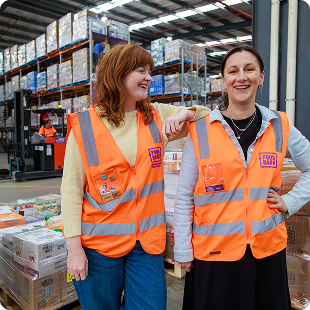

Volunteers backbone to fighting hunger, but more are needed

18 May 2018

 
Feeding hungry Victorians is a huge undertaking – and one that is largely reliant on volunteers.

Ahead of National Volunteer Week (21-27 May), Foodbank Victoria – the oldest and largest provider of emergency food relief – has released an online map to help link its charity partners with potential volunteers.

Foodbank Victoria CEO Dave McNamara said tens of thousands of Victorians would go hungry without the generosity of individuals motivated to make a positive contribution to their community.

“At Foodbank we’re fortunate to have up to 30 volunteers a day helping in our warehouse. Without them we simply wouldn’t be able to distribute the volume of food we do – the equivalent of one million meals each month,” he said.

“We’re lucky to have such a solid base of volunteers. However we know many of our charity partners all around Victoria are desperate for more hands to help carry out their vital work.”

A recent survey of Foodbank’s 400+ charity partners in Victoria revealed 40 per cent relied on volunteers to deliver their food relief programs (such as community pantries and soup kitchens) and 30 per cent were in need of more volunteers.

The map at lists Foodbank charity partners currently seeking volunteers. From Warrnambool to Wodonga to Orbost and everywhere in between, Mr McNamara encouraged people to consider volunteering at a local charity.

“There are a lot of amazing individuals out there who are the backbone of many charities, and the social services sector generally. But with one in five children in Australia going hungry each year, the pressure on charities to do more is increasing.”

The map also lists state primary schools who need additional help to run their School Breakfast Clubs. Foodbank Victoria, in partnership with the Victorian Government, provides up to 50,000 breakfasts a week through the program. Volunteers are required for an hour before school to help set-up breakfast and socialise with the students.

Last year, over 2000 volunteers donated almost 25,000 hours of their time at Foodbank’s Yarraville warehouse.

MEDIA ENQUIRIES

Kimberley Nichols, Foodbank Victoria: 03 9362 8309
Alexa Viani, Foodbank Victoria: 03 9362 8333 

15 April 2018 – Australia’s largest hunger relief organisation, Foodbank, has revealed that it is more likely for a child in Australia to go hungry than an adult in 2018.

This morning, Foodbank released its first ever research report on the prevalence of child hunger in Australia. Entitled Rumbling Tummies, the report found that while 15% of Australian adults have experienced food insecurity in the last year, more than 1 in 5 children in Australia (22%) have experienced food insecurity over the same period.

Foodbank found hunger amongst Australian kids is more common than once imagined, with 1 in 3 parents living in food insecure homes saying their children go hungry at least once a month. Meanwhile, at least once a week, 18% of food insecure children go to school without eating breakfast, 15% go to school without a packed lunch or lunch money and 11% go to bed without eating dinner.

With data collated from more than a thousand Australian parents with children under the age of 15, Foodbank uncovered that the major factor driving the growing need for hunger relief in Australia is the rising cost of living. An unexpected bill or expense (52%) and house payments (38%) are two of the most prominent causes of food insecurity in homes with children under 15, the organisation found.

Foodbank Australia’s CEO, Brianna Casey, said, “It is both heartbreaking and unacceptable to hear that children are going hungry anywhere in the world, let alone in Australia. As the cost of living continues to rise, parents are really feeling the strain of these financial pressures on their household budgets, forcing some to make impossible decisions for their families. Nine out of ten of these parents tell us that they have skipped meals so their children can have food on their plates, with 36% skipping meals on a weekly basis.”

Foodbank provides food for over 652,000 people a month, however, their front-line charity partners report that demand for food relief has increased by 10% in the last year. Furthermore, they are forced to turn away 65,000 people every month due to lack of food.

“As a community, we might be excused for not hearing one child’s stomach rumbling, but we simply cannot ignore the sound of thousands of children going hungry in Australia each day,” said Casey.

“If we want all our children to thrive and succeed, we can’t let their hunger go unheard. Whether you are from corporate Australia, government, or someone who believes in a better Australia, we really do owe it to these children to ensure Foodbank can get more food to the most vulnerable in our community,” Casey concluded.