Encompass Care

Working with more than 50 organisations across the northern region of Melbourne, Encompass Care focuses on helping disadvantaged people get back on their feet during tough times.

Gianna Donato, Chief Operations Officer, has worked at Encompass Care for seven years and says her role is diverse and no day is ever the same.

“You never know what situation you are going to encounter, it ranges from ordering food, to doing intake interviews, running a session for Community Café, attending meetings, volunteer training and more.”

Encompass Care currently runs a food crisis referral on Tuesdays and Wednesdays and feeds the community for a morning tea and lunch every Tuesday through the onsite Community Café. Through these programs, they are currently providing food relief to around 550 people each week.

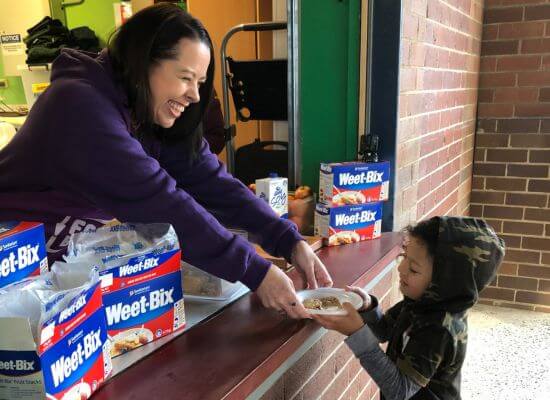
They also work with three local schools to help feed more than 400 students a week. Through a program called Unicare, they provide study packs with snacks, and sometimes hot soup, to international students at a nearby university.

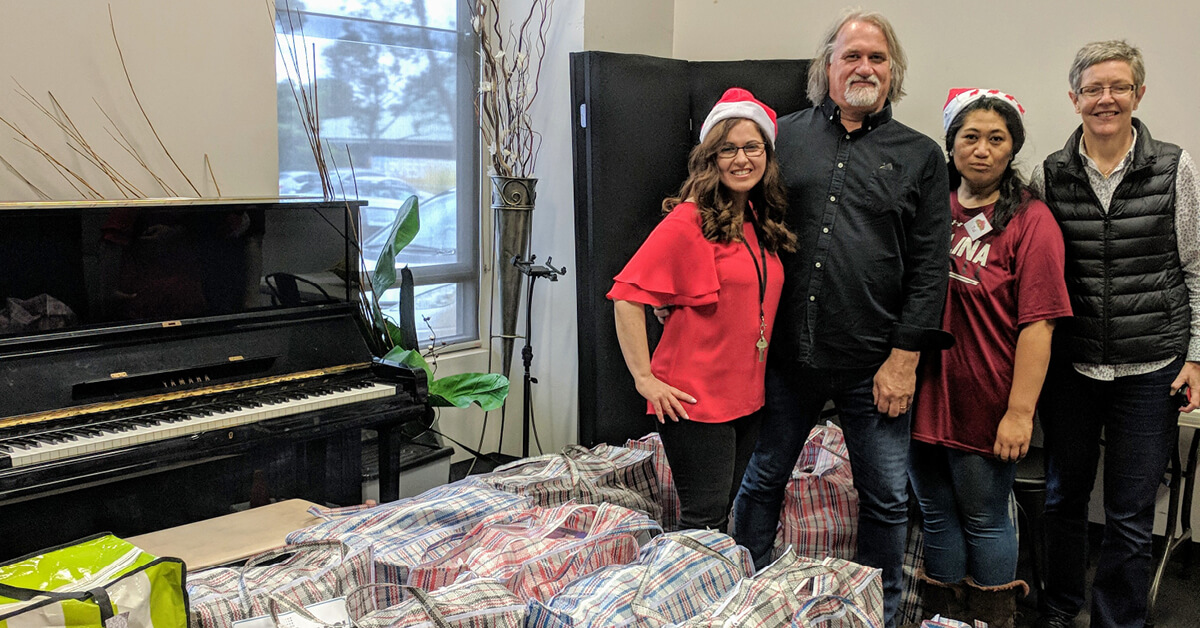
Last week Encompass Care held their annual Christmas Luncheon, which saw around 180 of their guests attending.

“The luncheon is a wonderful time for our guests to gather and be treated with a beautiful warm Christmas lunch. We love to spoil our guests and make them feel special, they also get a Christmas hamper after the event to take away. It’s about giving people a chance to have a bit of joy,” said Gianna.

When asked what is on the cards for the year ahead, Gianna said:

“Working with an amazing team of volunteers, helping more individuals and being a part of people’s story so they move forward and find hope. We look forward to having a greater impact on our local community. There are so many things we are still yet to do for our community.”

Visit the Encompass Care Facebook page to find out more.

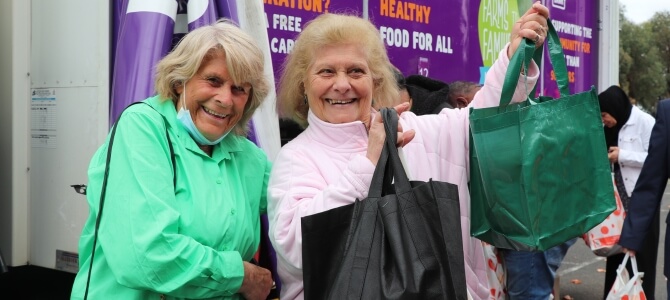
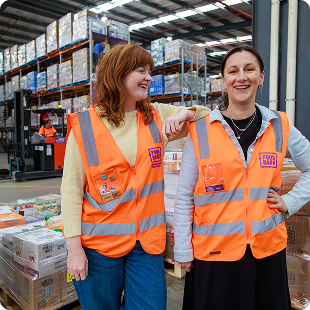
Image (left to right): Gianna, Brien from Foodbank, volunteer Tuli, and Kate from Foodbank, at the Christmas Luncheon.
Meet our charity partners

MasterChef finalist teams up with Foodbank to launch new range of recipe cards

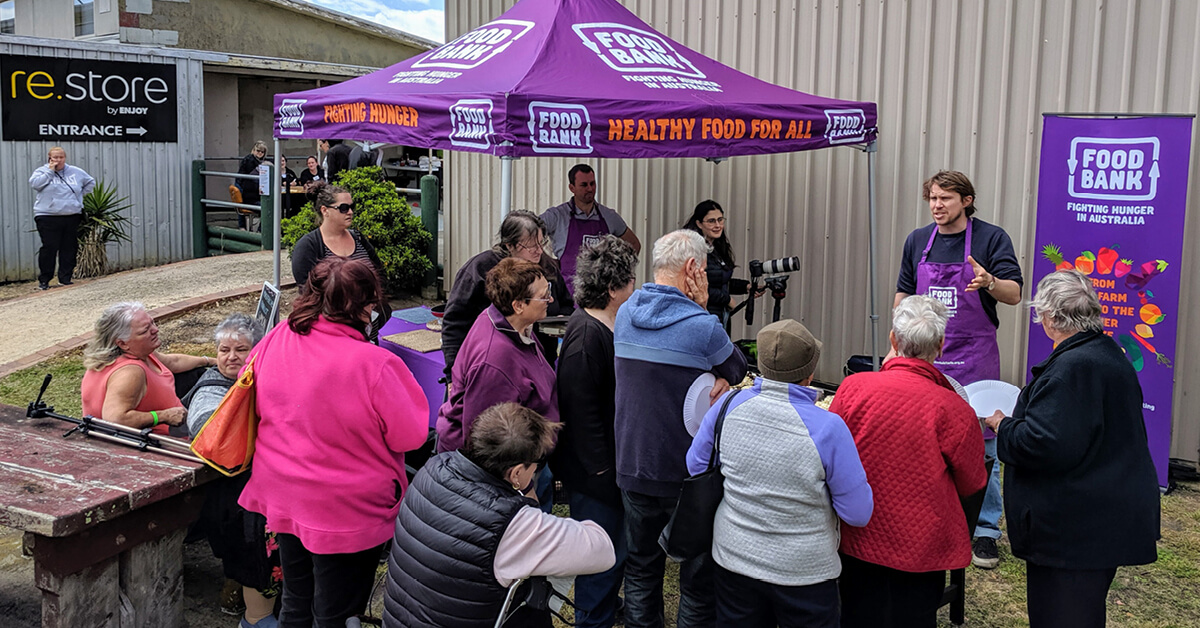
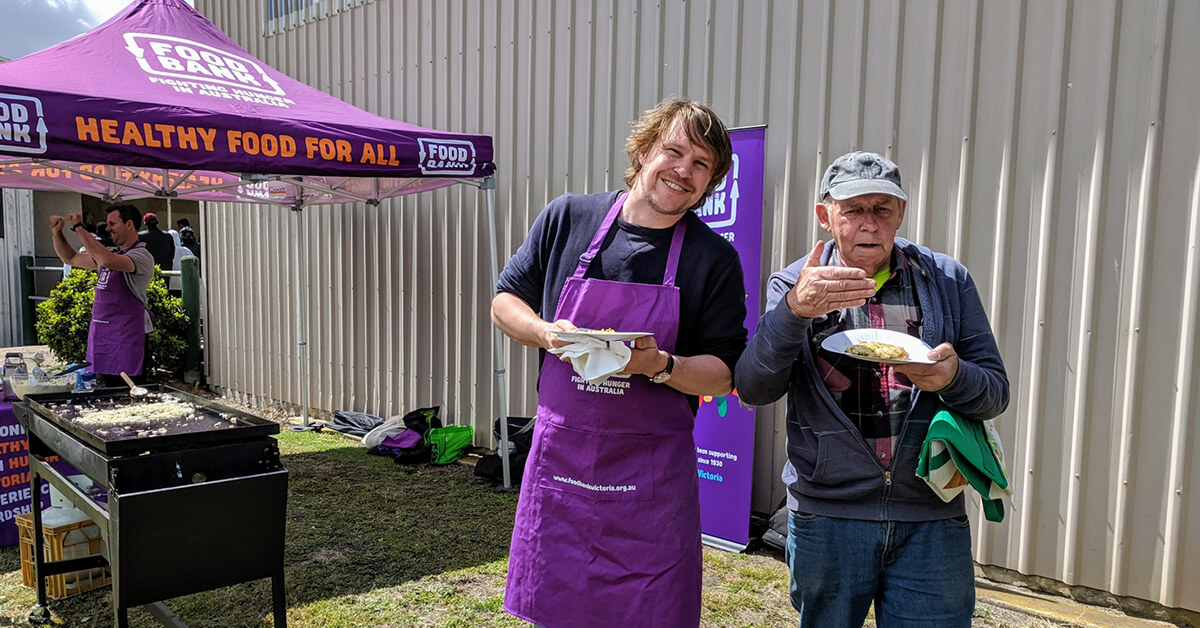
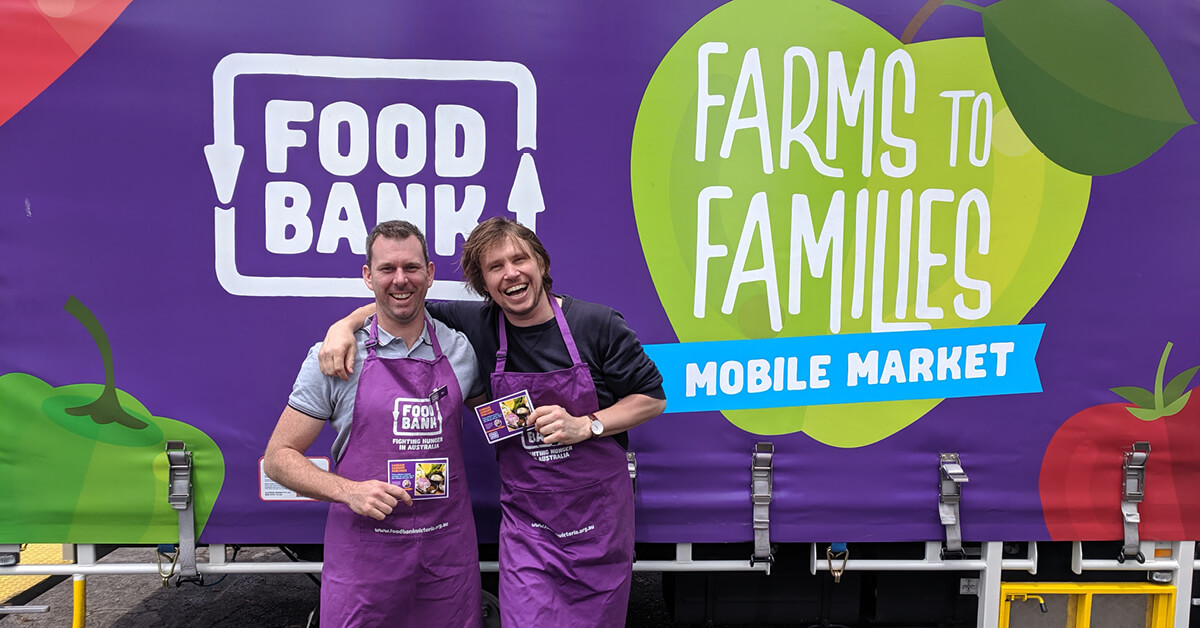
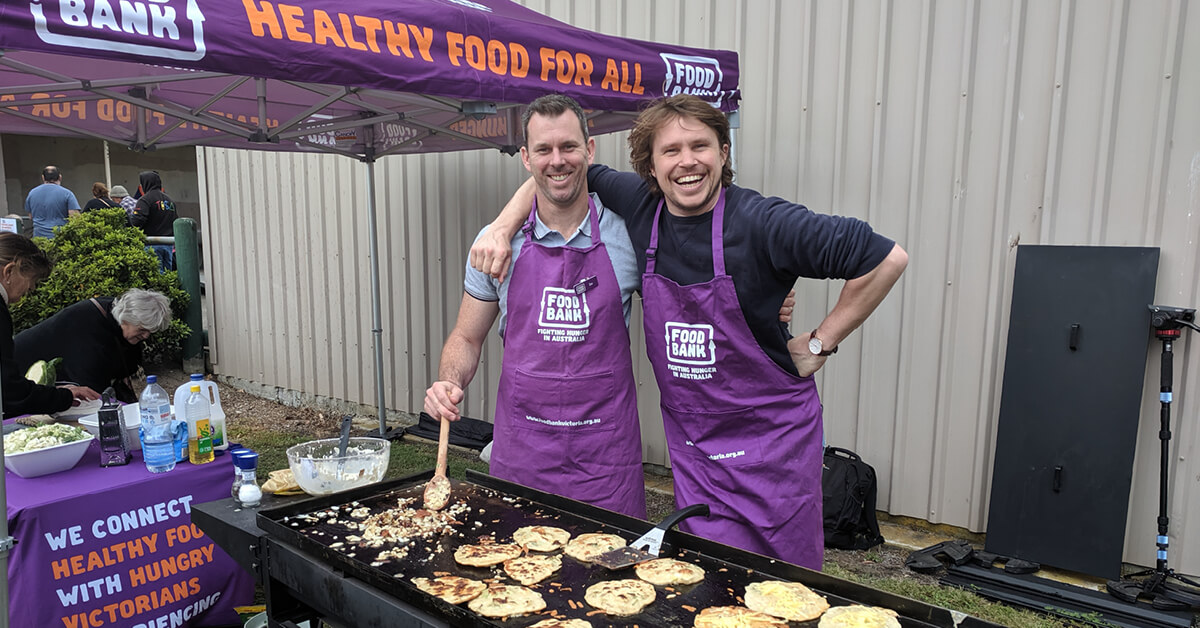
Morwell community members enjoyed an extra special addition to Foodbank Victoria’s mobile market on Friday, 6 December – a cooking demonstration by MasterChef finalist, Simon Toohey.

Donning a purple apron, Simon braved the windy weather to help Foodbank Victoria launch a brand new range of recipe cards that promote simple, low-cost and healthy eating.

Held monthly in Morwell, the pop-up market provides free, nutritious and fresh produce to clients of local charities. The recipe cards aim to encourage market attendees to create nutritious meals from the fruit and vegetables that are regularly available.

Simon, who is an advocate for waste-free and sustainable eating, helped Foodbank Victoria develop some of the recipes.

“Foodbank’s model of rescuing edible produce and redistributing it to those in need strongly aligns with my ambition of creating a sustainable future and I am just thrilled to be working with Foodbank to help get people excited about fresh produce,” said Simon Toohey.

Simon’s recipe for ‘Cabbage Savoury Pancakes’ is just one of the delicious offerings included in the range – which proved to be a crowd pleaser on the day.

“These are delicious! I’m going to try them with a hint of garlic,” said a Market attendee.

Working with several charity partners in Morwell including, Enjoy Church, Theodora’s Cheerful Givers, Morwell Neighbourhood House, the Salvation Army and The Gathering Place, the market can assist up to 300 families in the community. And while providing food is vital, promoting healthy eating is just as important.

“Through these new recipe cards, we are helping Victorians better understand nutrition and encouraging them to cook with vegetables they might not be too familiar with. We also understand families are busy, and the recipes offer quick and healthy meal options for those with demanding schedules,” said Dave McNamara, Foodbank Victoria CEO.

We cannot thank Simon enough for his ongoing support of the work that we do.

Foodbank releases ‘Most Wanted’ list for Christmas giving

Christmas can be a tough time for many Australians, particularly those in our communities struggling to put a meal on the table, or trying to fill hungry bellies these school holidays. More than one in five Australians have experienced food poverty in the past 12 months – that is, they have run out of food and are unable to buy more. These are everyday Australians who have fallen on tough times, whether it be related to drought or natural disasters, job loss, rental or housing unaffordability, unexpected expense or a serious medical condition.

Foodbank Australia is working hard right across the country to ensure families and individuals can put a meal on the table – not only on Christmas day – but for as long as it takes to get them back on their feet. This means sourcing and distributing massive volumes of food and groceries.

At this time of year Foodbank relies on donations of wonderful fresh produce from farmers right across Australia; a mix of products from the Australian food and grocery manufacturing sector and retailers; food donated from food drives held by preschools, schools, community groups and corporate Australia; and financial donations through fundraising appeals. With both drought and bushfires affecting so much of Australia right now, the need for donations has never been higher.

Foodbank Australia CEO, Brianna Casey, said, “It’s an absolute joy to see so many people holding food drives to ensure Foodbank can get more food and grocery items to vulnerable families this Christmas. However, we strongly encourage people to consult our ‘most wanted’ list before embarking on food drives to ensure they are focusing on the food and grocery items in strongest demand.”

Foodbank’s most wanted items this Christmas include everyday non-perishable items like breakfast cereal, pasta, noodles, rice, tea and coffee, canned fruit, vegetables, pulses, long-life milk, baked beans, tinned spaghetti, personal hygiene products, spreads like vegemite and honey. Christmas treats like Christmas cake or pudding, UHT custard or shortbread also make the world of difference during the holiday season.

“It’s times like this that we see Australians at their absolute best, supporting the most vulnerable in our communities through their generosity and kindness”.

Foodbank’s ‘Most Wanted’ Items

  • Breakfast cereal such as Weet-Bix and Cornflakes
  • Pasta, noodles and rice
  • Tea and coffee
  • Long life milk
  • Canned fruit, vegetables and tuna
  • Baked beans and spaghetti
  • Spreads like jam, peanut butter and Vegemite
  • Shelf stable meals, eg meals that can be stored at room temperature in a sealed container
  • Personal hygiene products such as shampoo, conditioner, toothpaste and toilet paper

Food waste in Australia

Did you know Australia produces enough food to feed everyone three times over? Yet 3.4 million households struggled to put a meal on their table last year.

Australia currently creates more than 7.6 million tonnes of food waste each year – enough to fill the Melbourne Cricket Grounds nine times. This is costing the Australian economy over $36.6 billion despite 70 percent of it is perfectly edible.

Around 10 percent of global greenhouse gas emissions come from food produced but wasted. In Australia, this represents 17.5 million tonnes of CO2 each year.

Australia is committed to the United Nations Sustainable Development Goal (12.3) to half food waste by 2030. We have a plan to help reach that goal. Foodbank’s food and grocery rescue operations saved 86.6 million kilograms of CO2 emissions in 2022*. We are an active participant in Stop Food Waste Australia and the Fight Food Waste Cooperative Research Centre, which are both committed to halving food waste by 2030.

We are also advocating the government to adopt a National Food Donation Tax Incentive, developed by KPMG Australia, with the support of the Fight Food Waste CRC and the food relief sector. If implemented today, this tax incentive would save around an additional 100 million meals a year by 2030, making an immeasurable difference to our sustainability and the well-being of vulnerable Australians.

Incentives along the same lines as our proposal are currently working successfully in the USA, France, Canada and the Netherlands. This approach has the potential to help generate social, economic and environmental benefits valued at $2 billion per annum. It would directly assist in achieving our ambitious food waste reduction target.

How can I help prevent food waste in my home?

More than a third of Australia’s food waste is generated in the home, so we all have a part to play. We often waste food because of confusion between best-before and use-by dates or because we’re unsure whether leftovers are safe to reheat. A little bit of food-handling knowledge goes a long way! To help fight food waste in your home, it’s as easy as clickinghere. With the average Aussie household wasting $3,800 every year thanks to wasting food, it’s worth the effort!

Do you have food or stock to donate?

School Spotlight: Stawell Primary School

For over 10 years, students have been enjoying Breakfast Club as a healthy and positive way to start their school day.

We chatted to Michael Lewis, Chaplain of Stawell Primary School, about the benefits of the program.

He said, “We are grateful to our committed volunteers who run the program and to Foodbank for providing our breakfast food.

“We are also grateful to a generous local bakery for donating bread every week. Breakfast time is a time for lively conversations and building friendships in a safe, happy environment.

“At breakfast, music plays a big part in creating a fun and relaxing atmosphere. We play a musical guessing-game, where students guess what movie a piece of music comes from, to win extra toast and bragging rights.

“We also ask students to share three things they are grateful for; which has sparked conversations about a wide variety of things, like being grateful for fresh morning air, birds singing, a favourite toy or sport, and special relationships. This adds up to students having a positive mindset and outlook on life.”

Want to share what you do to engage the school community with breakfast club? Email us at schoolbreakfastclub@foodbankvictoria.org.au

Read more School Breakfast Club stories

FOOD HAMPERS EASE THE PRESSURE FOR FARMING FAMILIES IN DROUGHT

Foodbank NSW & ACT hit the road in September with one aim, to distribute 5,000 hampers to drought stricken communities across the state.

The drought hamper rollout also ticked over our 150 million meal milestone.  Foodbank NSW & ACT CEO Gerry Andersen said it’s not a milestone the organisation wanted to reach.

“We are in the worst drought in history. We understand it’s not going to be fixed in the short term, even if it rained tomorrow,” he said.

In conjunction with The Country Women’s Association and other charity partners, Foodbank were able to distribute hampers throughout the Central West and the Northern parts of the state.

Natalie Quince from Anglicare in Parkes says with the whole of the Central West in drought, most farmers are beyond breaking point. *

“We’ve had some farmers tell us that they have been eating mandarins off their tree for the last 3 days because that’s pretty much all that they had left to eat.”  

The five thousand hampers contained premium staples such as breakfast cereal, milk, rice, pasta and sauces, canned meals, tea and coffee.

With no end to the drought in sight, Mr Andersen is urging people to continue to partner with Foodbank in the fight against hunger.

“We’re in this for the long haul with our farming communities but we couldn’t do this without the support of our donors and volunteers who help fund and pack what we give out to those that need it every single day,” Mr Andersen said.

“And to the people who receive our hampers, we understand the mental anguish.  Don’t give up, if you need some help, put your hand up, because there are a lot of people who are prepared to help.”

Mr Andersen says the personal feedback and thank you letters coming in have been heartfelt.  Many are 4 and 5 generation farming families who have been on the land for more than 100 years.

“Your generosity was overwhelming and the care behind that amazing box of goodies actually made me cry. In tough times like this the smallest things can make an enormous difference. The fact people are concerned and really care is good for our souls,” said one farming family from Armidale.

“Our family is one of many who are finding the going tough and with no end of the drought in sight, we don’t know where we will end up.  We have never in our lives have had to accept help and we are embarrassed to have to now.  But we do have to survive and need to swallow our pride and be eternally grateful for what others can offer. Any help in the future would be gratefully accepted,” said another farming family from Scone.

Support our farming communities today.

Donate Today

featured image

YOUR SUPPORT HAS RELIEVED MY STRESS

You might remember Katherine from our August newsletter, one-minute Katherine was a hard-working mother of five, who proudly saved up enough money to take her family on a once in a lifetime holiday on the Pacific Islands. Fast forward just a few months and she was unemployed, alone and struggling to feed her family.

featured image

Foodbank’s latest Hunger Report reveals that women in Australia are 50% more likely to experience food insecurity than men especially while raising children on their own for an extended period of time. Katherine is one of the faces of this harsh reality.

Foodbank NSW & ACT CEO, Gerry Andersen, explained this type of situation along with domestic violence and financial abuse, make women bear the brunt of food insecurity in Australia and much more susceptible to food stress.

“No mother should have to wonder how they are going to put food on the table for their children. It’s heartbreaking and distressing that this is occurring right here, in our own backyard,” said Gerry Andersen.

Since going to the Foodbank pantry on a regular basis, Katherine has been feeling less worried knowing that she can access food and groceries to feed her family. She also started volunteering in the Foodbank pantry as a way to give back for the help and hope that she has received while she looks for a new job.

“Thank you so much for your generous donations. It helps to relieve my stress, knowing that I can provide to my family in this difficult time,” said Katherine.

FOODBANK PARTNERS WITH COLD CHISEL

We are very excited to be partnering with Cold Chisel this summer on their Blood Moon Tour.

Since forming in Adelaide in 1973 and blasting onto the national scene in the late 70s, Cold Chisel has created a uniquely Australian fusion of rockabilly, roughhouse soul, and blues.

For the first time ever, the legendary Australian band will play 14 very special outdoor shows during summer on their Blood Moon Tour. They’ll do gigs on the beach, gigs by the river and gigs in the bush. They will play six venues across NSW and the ACT.

Cold Chisel will be supporting Foodbank in various ways throughout the tour including by way of special auction items and fundraising collections at each venue on the tour.

“Foodbank provides more than 815,000 people with food relief every month around Australia”, explains Ian Moss. “They did that by making use of good food and produce that would have gone to waste otherwise. We wish there wasn’t so much demand for their services but we’re pleased to do our bit to help them out.”

Tickets are on sale now. We hope to see you at one of the concerts!

featured image

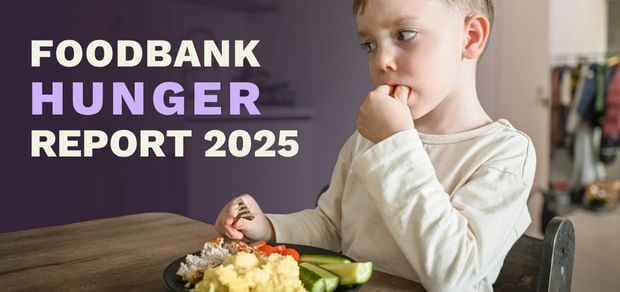
Hunger Report reveals food insecurity in Victoria is on the rise

Foodbank’s latest Hunger Report reveals that women in Australia are 50% more likely to experience food insecurity than men. In fact, a quarter of all women have experienced food insecurity in some form in the past 12 months.

The Foodbank Hunger Report 2019 discloses that the events that make women susceptible to food stress are also different to those for men. Women are significantly more likely at some time in their lives to have experienced domestic violence or financial abuse or raised children on their own for an extended time. Men, on the other hand, are more likely to have been unable to find a job for a lengthy period.

The Foodbank Hunger Report, now in its seventh year, surveys 2,000 charities and 1,000 individuals experiencing food insecurity from around the country. Foodbank Victoria CEO, Dave McNamara, explained that the report aims to better understand and explore what is a growing social crisis.

“The impacts of food insecurity are far beyond just feeling hungry. The report highlights the devastating mental health and wellbeing implications of experiencing food insecurity – especially for women,” said Mr McNamara.

Alarmingly, the data shows that 70% of food insecure Australians experience high or very high levels of psychological distress compared to only 13% of the general population. With mothers twice as likely as fathers to feel like a bad parent when there is not enough food in the house.

“The face of hunger in this country is changing. And sadly, it’s some of the most vulnerable in our community who are suffering. Feelings of shame, guilt and embarrassment, tend to act as barriers for people accessing food relief.”

“No parent should have to wonder how they are going to put food on the table for their families. It’s heartbreaking and distressing that this is occurring right here, in our own backyard,” said Mr McNamara.

In Victoria, Foodbank currently works with over 430 charity partners to provide enough food for 1.2 million meals a month. Concerningly, Victorian charities have reported a 25% increase in the number of people seeking food relief over the past 12 months.

“With the rising cost of living, we’ve seen the demand for food relief continue to rise. Despite assisting more than 140,000 Victorians monthly, our partners have reported an estimated 8,000 Victorians are unable to be assisted each month due to lack of resources.”

“How many Australians need to go hungry before we see real action to address this hunger crisis?” Mr McNamara said.

“At a federal level, we need a bi-partisan, whole-of-government plan to tackle the crisis. We are calling for a commitment to introduce a National Food Security Strategy to ensure we achieve zero hunger in Australia by 2030.”

MEDIA ENQUIRIES

Alexa Viani
Marketing & Communications Officer
alexav@foodbankvictoria.org.au
0466 459 266 or 03 9362 8333

Hunger hits women the most as SA hits record need 

13 October 2019

  • In SA, there has been a 15% increase of those requiring food relief from the previous year
  • Foodbank SA currently supports more than 126,000 people with Food Relief each month, through agency relationships, Food Hubs and School Programs
  • In SA around 134,620 individuals are seeking food relief each month including via school relief programs – with more than 7876 people unable to be provided with food each month
  • Women are 50% more likely to experience food insecurity than men.


A new Foodbank survey has found that more South Australians that ever are seeking food relief – with a staggering 134,620 people asking for help each month – up 15% from last year.

The report, released today by Foodbank SA, highlights that the demand continues to grow, with women bearing the brunt of food insecurity.

The Foodbank Hunger Report, now in its seventh year, surveys 2,000 charities and 1,000 individuals experiencing food insecurity from around the country.

In South Australia, the need continues to grow with more than 126,000 people seeking food relief each month – increase from last year’s 117,260. These are provided through a range of services such as agency support, Food Hubs and school programs.

Foodbank currently runs five Food Hubs across SA, as well as a Mobile Food Van which is used to take food to communities that are remote or not close to an existing Food Hub.

Foodbank SA chief executive Greg Pattinson said it was a very sad fact that the demand still could not be met.

“The fact that we can’t get enough food to enough people is still a significant issue,” he said.

“Despite our best efforts, we still can’t get to the parts of the state that really need our help, either due to the high cost of transport, logistics or that we just can’t get enough food to take to them.”

Mr Pattinson called on the State Government to do more to fix the problem.

“There shouldn’t be more than 7000 South Australians every month worrying about where they are going to get their next meal,” he said.

“We need significantly more funding support from the SA Government if we are to get closer to bridging this gap.”

Media Enquiries: .

Sarah Davies, 0432 511 091 
Jenny Turner, 0412 155 245